Education
Trichology 101: Scalp and hair health explained
Understanding the basics of scalp and hair science will set the foundations to build your knowledge of your own scalp and hair so you can properly care for it.
What is trichology?
Trichology is the study of the hair and scalp. It sits between hair care and health care: the aim isn’t to make hair look good for a day, but to understand why it is behaving as it is, and build a plan that works to sustain a healthy scalp and hair.
The difference is in the questions being asked
The difference isn’t skill or care — it’s the questions being asked, that sets the tone for the direction of your care.
A styling appointment asks
“What would you like it to look like?”
VS
A trichology appointment asks
“What is your scalp doing, and why?”
The MelanoTresses Method approaches your appointment with Assessment, Profiling and Education before we finalise and adorn your crown with a style. See it set out step by step on The MelanoTresses Method.
Structure, not stereotype
Textured Hair Science
Three structural facts explain most of the difference. None of them is about hair being weak, they’re about hair being shaped differently.
Curl pattern changes how scalp oil reaches the ends
Sebum — the oil your scalp produces — is the hair’s own conditioner, and on a straight strand it slides down the length with very little help. On a coiled strand it has to negotiate every turn, so it tends to stay near the scalp while the lengths and ends stay comparatively dry.
In practice This is why textured hair can genuinely be oily at the root and parched at the ends on the same day, and why moisture usually has to be applied deliberately rather than left to arrive on its own.
Every bend in the strand is a natural stress point
A curl-textured hair strand has a flattened, elliptical cross-section compared with straighter hair strands, which are more circular or oval. This characteristic influences the curling nature of textured hair. At each turn the strand narrows and the cuticle scales lift slightly out of alignment. Those turns are where force concentrates when hair is combed, stretched, detangled or pulled through a style.
In practice It’s why breakage in textured hair so often shows up mid-strand at a curve rather than as shedding from the root — and why the two look similar in the sink but mean completely different things.
The load is cumulative, not one bad appointment
Protective styles, heat, colour and chemical processing each place a different demand on the strand and the follicle: tension at the root, altered internal bonds along the length, lifted cuticle at the surface. Any one of them, spaced out and done well, may be entirely manageable.
In practice Difficulty usually builds where they stack with no recovery between — which is why a specialist asks about the last two years of your hair, not just the last two weeks.
Despite textured hair being generally finer in diameter amongst all hair types, it is perceived to have a higher volume due to the tight coils the strands create. This appearance has long influenced the manner in which textured hair is handled, which is commonly harshly.
In practice: textured hair requires strategic handling, detangling and minimised use of harsh chemicals and heat styling to protect the individual fibres from breakage.
Our Assessment
Why an assessment must come first
Two very different problems can look identical in the mirror. Tension loss at the hairline and hair shedding due to a hormonal change in the body both read as “my hair is coming out”. Acting on the wrong conclusion can cost months of lost time and effort. Assessments are what decide the treatment: the scalp examined directly, a proper history taken, and a baseline recorded so change can be measured.
What assessment can tell you
- Whether hair is breaking along the strand or shedding from the root
- Whether density has changed evenly across the scalp or in a pattern
- Whether the scalp shows signs of irritation
- Whether a hairline change matches a tension pattern, and how far it has progressed
- Whether any of your signs and symptoms warrants a GP or dermatologist referral and further tests
How we look, and what you take home
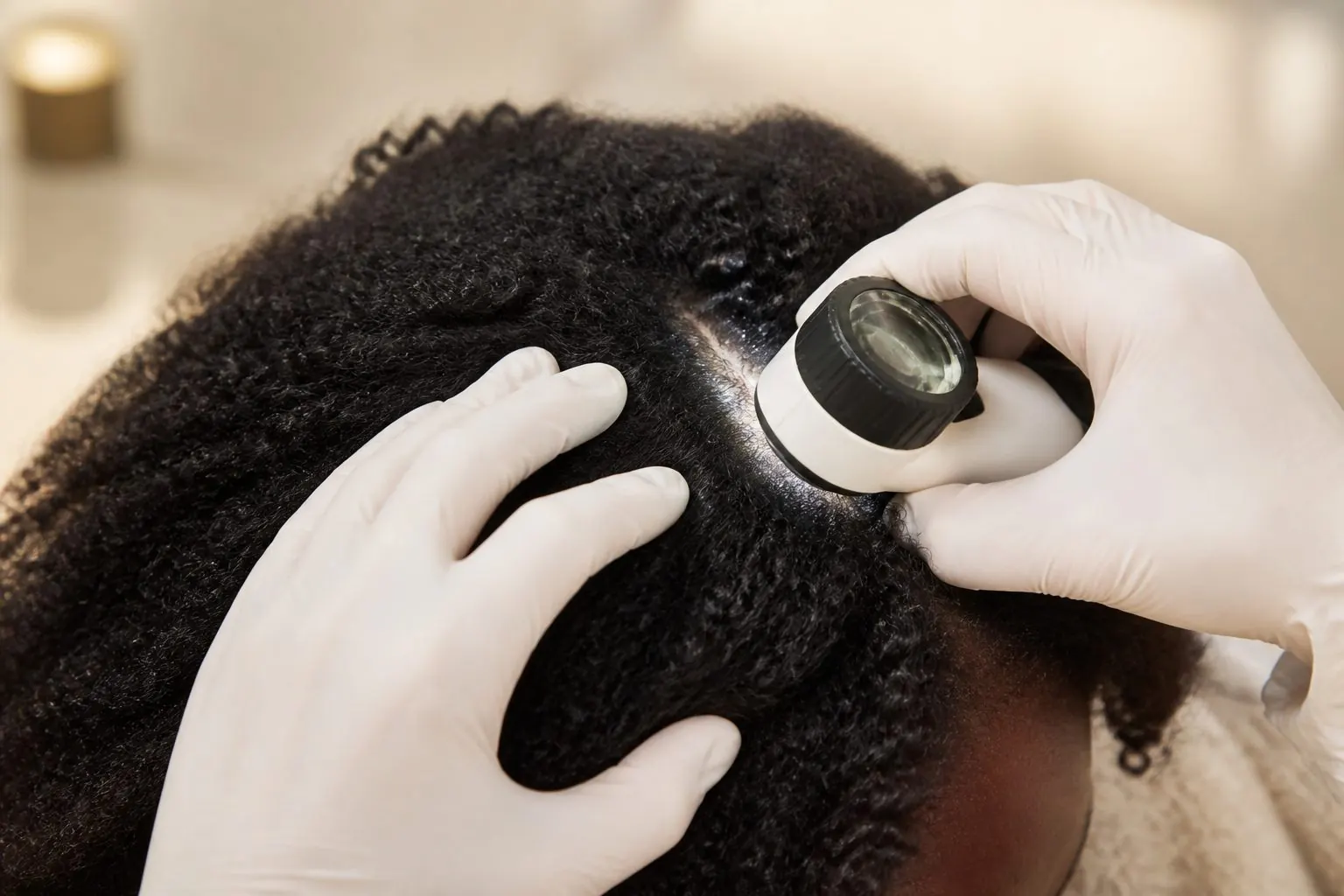
During a trichology consultation, a thorough history is taken, trichoscope imaging of your scalp is recorded and a wood lamp may be used to further examine your scalp. What is found is recorded in a consultation form, which you receive after your appointment.
Our thorough process allows us to make confident decisions and create plans for the care and health of your hair. See how the Hair Care Plans are structured.
Discover your scalp health
Have your scalp properly assessed
£70 · 1 hour · in-studio
Common conditions
What people bring to a consultation, and what’s happening underneath
These are things worth discussing with a specialist — general information about how hair and scalp behave, not a diagnosis or a treatment recommendation for any individual.
Breakage
What it looks like
Hair snapping part-way along the strand rather than shedding from the root — short pieces, uneven lengths, a length that never seems to move.
Why it’s worth assessing
Broken hair has a blunt, torn end; shed hair carries a small pale bulb. The distinction points in different directions: mechanical stress, chemical history and moisture balance are all possible contributors, and they call for different responses.
Thinning or reduced density
What it looks like
Less hair overall, a part that looks wider than it used to, or a hairline that has changed shape.
Why it’s worth assessing
Density can change for many reasons — some to do with the scalp, some not to do with hair at all. That range is exactly why a specialist assesses before recommending anything, and why some concerns are better taken to a GP.
Tension from protective styles
What it looks like
Soreness after a style is installed, small bumps along the hairline, or fine hairs at the edges that never grow back to length.
Why it’s worth assessing
Follicles respond to sustained pull. Styles designed to protect hair can work against it when they’re installed too tight, sized too heavy, or worn too long without a break. It is one of the most common patterns in textured hair and one of the most worth raising early.
Scalp irritation and flaking
What it looks like
Itching, tightness, tenderness, or flaking that returns however often you wash.
Why it’s worth assessing
The scalp is skin, and it behaves like skin. Flaking can be about the scalp’s own condition or about what is being left on it, and those two look almost identical from the outside — which is a poor basis for choosing a product.
Product buildup
What it looks like
Hair that feels coated, refuses to absorb water, or goes limp and dull soon after washing.
Why it’s worth assessing
Heavy oils, butters and silicones can sit on the scalp and cuticle rather than absorbing into them. Once there is a film, everything applied afterwards works on the film instead of the hair — so a routine can be full of good products and still not be reaching anything.
Shedding after a life event
What it looks like
A noticeable increase in hair coming out from the root, often some months after childbirth, illness, significant stress or a change in medication.
Why it’s worth assessing
Hair grows in cycles and the whole head is not on the same clock. Events that affect the body can shift a proportion of hairs into their resting phase together, which shows up as a wave of shedding weeks later. This is a well-recognised pattern and a specific one — which is why it is worth having assessed rather than self-diagnosed from the internet.
When the honest answer is “see your GP”
Some hair and scalp changes have causes that sit outside hair care entirely. A trichologist’s job includes recognising when that may be the case and saying so, rather than starting a subscription regardless. Being told what is not ours to treat is part of what you’re paying for.
This page is general educational information about hair and scalp health. It isn’t medical advice, it isn’t a diagnosis, and nothing here predicts a result for any individual. If you have a concern, a consultation is the place to have it looked at properly.
Straight answers
Frequently Asked Questions
The ones that come up most often, answered without hedging.
Is a trichologist a doctor?
No. Trichology is the study of the hair and scalp, not a medical qualification, and a trichologist does not diagnose or treat medical conditions. A good one works the other way round from a salon — assessing first, and saying plainly when something belongs with your GP or a dermatologist rather than with them.
What is the difference between a trichologist and a hairdresser?
A hairdresser works on how hair looks and behaves today; that is a real craft and MelanoTresses does that work too, including bridal and occasion styling. Trichology asks a different question: what is the scalp and the follicle actually doing, and what pattern explains it. The two are complementary, not ranked.
Does Afro and textured hair really need different care?
Yes — for structural reasons rather than reputational ones. Scalp oil travels down a coiled strand less readily, each bend in the coil concentrates mechanical stress, and the styling practices common to textured hair add tension, heat and chemical history on top. Generic advice tends to miss all three.
Do I need a full Hair Care Plan to get an answer?
No. Everything starts with a consultation, and the point of a consultation is to find out what is going on — including the possibility that the answer is a change of routine rather than a Hair Care Plan.
Next
The Hair Care Plans
What each one covers, how long it runs, and what it costs.
Your crown, cared for
Curious what’s actually going on with your hair and scalp?
Book a consultation and find out properly — from someone who will explain what she’s seeing, and tell you honestly if a Hair Care Plan isn’t what you need.
Price
£70
Length
1 hour
Where
In-studio
Scalp assessed under magnification · written plan to take home · no obligation to continue

Newcastle upon Tyne
86 Adelaide Terrace · Est. 2018